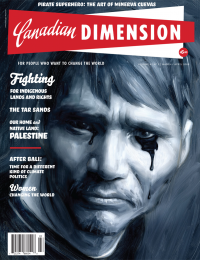
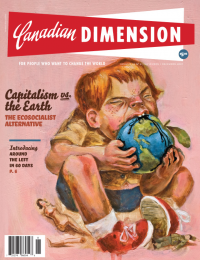
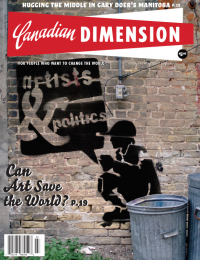
The CD story (so far), part 2
Reflecting on the second pair of decades for Canadian Dimension (1983-2003)

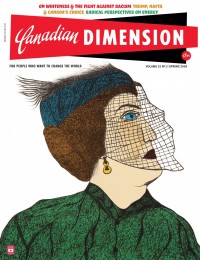
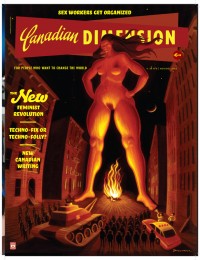
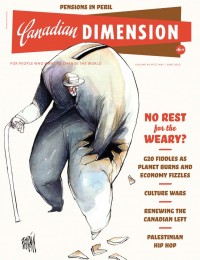
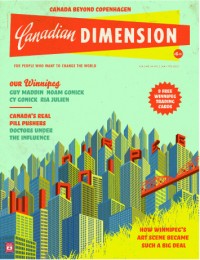
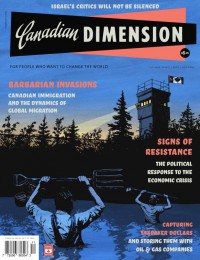
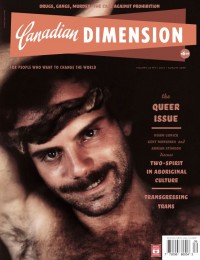
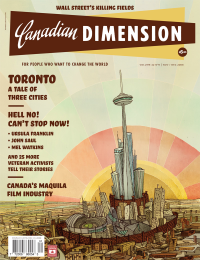
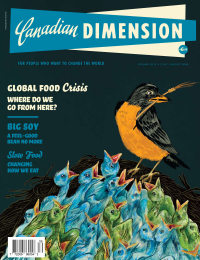
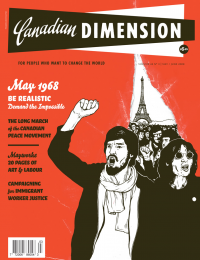
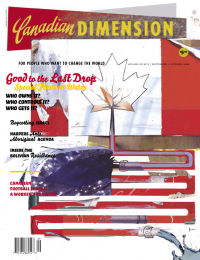
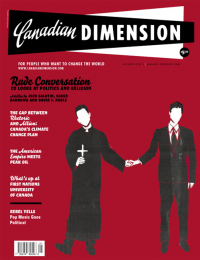
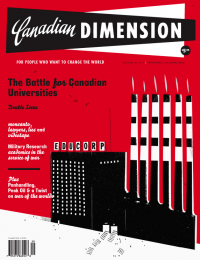
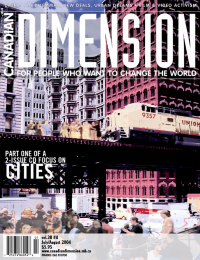
The cover of Canadian Dimension’s November/December 2003 issue.
There were several changes of the guard at CD as we entered our third decade and with them a decidedly more diverse content. More than ever before our collective was drawn from activists in various popular movements. But the new diversity arose from more than the changing composition of the collective. It also arose from our awareness that political consciousness - how people become involved in political action- is very complex and stems from a variety of experiences. People’s consciousness of their racial oppression or their sexual oppression, of the exploitation and degradation of nature, or of military or economic domination of the weak by the powerful - any of these may be as key a politicizing factor as their class exploitation.
So without sacrificing any of our other themes, clusters of articles with titles less likely to be found in earlier issues began appearing with regularity. Titles like: “Manufacturing Madness” (Don Weitz), “Heterosexuality - a Challenge to the Left” (Marian Valverde), “Rooting Out Male Violence” (editorial), The Trials of Harry Kopyto” (Marion Cohen), “Surrogate Motherhood” (Marsha Hewitt), “Is the Food Industry Killing Us?” (Chernomas), “The Left and Gay Liberation” (Tim McCaskell), “REAL Women: Really Dangerous” (Karen Dubinsky), “AIDS and the Crisis of Sexuality” (Jackie Larkin), “Why Women Smoke” (Charlene Toews), “Growing Old” (Ustun Reinart), “With God on Our Side” (Editorial), “Goon Masculinity” (Bruce Kidd), “Battered Wife Syndrome (Elizabeth Comack), “No Good Cops At OKA” (Editorial), “Contradictions of Sustainable Development” (Brewster Kneen), “The Politics of Greenpeace” (Bruce Livesay), “A Politics of Intimate Life” (Roberta Hamilton).
Many of these and other articles stemmed from a commitment of the CD collective back in 1983 to devote more space to the politics of the popular movements - women, aboriginal, environmental, peace, faith communities, etc. In our editorial statement of September, 1983, we outlined some principles that would govern the editorial direction of the magazine for several years.
The lives of many people, not all of them workers, are shaped by the disadvantages they experience on the basis of their origins, skin colour, sex, nationality, language, sexual orientation. Focusing on the lives of people in their workplaces while ignoring other parts of their lives and the communities they relate to needs to be corrected. The Left and the labour movement should be taking up the concerns of all who face oppression and building alliances with popular movements.
Our vision of socialism and our politics must incorporate the insights of feminism. Feminism challenges the separation of the private from the political - for individuals but also for movement organizations. It proves the possibility of collective action around private areas of life once considered personal and unchangeable - like childcare, sex education, abortion, violence and abuse. It also poses a critique and offers alternative methods of organization and doing politics, insisting on living aspects of our future vision in our present.
Popular movements and coalitions, as important as they are, are not substitutes for a socialist party that alone can link up the struggles against exploitation and oppression, build new visions of a socialist future, and develop projects and strategies for mass mobilization.
While none of this was entirely new for CD, the change in accent was immediately obvious. It was reflected in our choice of regular columns, a feature that stems from this time - columns like Living Our Politics, Half the Sky …and Then Some, Personal/Political, Green Web. And it’s interesting that many of the articles that proved to be the most controversial among our readers were ones that related to personal/political issues. In the nineties we added community action to the CD menu. Of course, CD never stopped discussing the more traditional issues of class, workplace, unions, Quebec sovereignty, economy and parties. In fact, some of our most useful issues in the last 20 years were those focusing on moments of intense class confrontation: BC Solidarity (March 1984 issue), The Anti-Free Trade Campaign (1989, various issues), Ontario’s Days of Action (1996, 1997, various issues), Queens Park Riot (Sept/Oct 2000) and Quebec City (May/June 2001 and July/August 2001).
The Labour Beat
Geoff Bickerton’s CD column is widely recognized as this country’s most informed and insightful commentary on Canada’s labour movement. Begun in 1987, it has appeared continuously for 16 years and is read with much anticipation by labour activists from every sector. In many respects, Geoff’s column continues in the tradition of Ed Finn who wrote often on labour matters in Dimension’s earlier years.
Besides analyzing the internal life of the labour movement - its history, strategies and struggles, Dimension has been no less concerned with the plight of unorganized workers, with labour legislation and labour standards and most particularly with how capital organizes and re-organizes the workplace to extract more profit from its workers.
Besides Geoff Bickerton, there have been numerous other regular contributors on these subjects. Assembly-line worker turned academic, Don Wells, union researchers Sam Gindin, Marvin Gandall, Gil Levine and John Calvert, Osgood Hall Law School’s Judy Fudge and Harry Glasbeek, historians Bryan Palmer, David Frank, James Naylor and Craig Heron, labour studies professor Charlotte Yates, health and safety activist Stan Gray, rank-and-file worker Marion Pollock, academics Pauline Villaincourt, Leo Panitch and Donald Swartz - all have contributed frequently and insightfully on issues related to the workplace, working class history, government legislation and the dynamics of Canada’s and Quebec’s labour movement.
Covering Indian Country
In recent years, the Canadian media has recognized that Canada’s colonized First Nations peoples are this country’s most exploited and oppressed - something long known by Dimension readers. Back in the 1980s, Chief Moses Okimaw contributed the award winning “God’s River and the Manitoba Government Great Expectation Meets the Prodigal Son”. Regina researcher Ron Boureault wrote about “Canadian Indians - the South African Connection” and “The Killing of Leo LaChance”. Journalist Ustun Reinart told the stories about the murder of Helen Betty Osborne, Winnipeg’s Indigenous Women’s Collective and about how Winnipeg’s native peoples were taking over child care. Prison reform advocate Ruth Morris wrote about “Native People in the Canadian Justice System” and Dimension’s Fred Gudmunson revealed the exploitative relationship between “Exxon and the Dene”. Our collective wrote an editorial -“Native Education: Paid in Advance; Paid in Full”.
In the 1990s, the CD collective wrote editorials on “Reflections on Oka” and “The Year Before Columbus” (1991 being the 500th anniversary of Columbus’s voyage to the New World’). Lori Foster and Dave Broad wrote about “Innu Rights, World Peace and the Environment”. Historian Tony Hall contributed several articles including “Who Killed Dudley George - Reflections on Ipperwash and Gustafson Lake” and “The Politics of Aboriginality”. I interviewed Milton Born With A Tooth and wrote “Save the Oldman River”. Native writer Marylin Fontaine Brightstar’s “Breaking the Silence” broke ground about the sexual abuse and exploitation of native women and children.
CD’s commitment to covering “Indian country” has continued over the past five years along with the struggles against internal colonialism. Native barrister Ardeth Walkem and Gabriel Haythornthwaite both contributed articles on Nisga’a style treaties. Journalist Parker Barss Donham devoted several of his Atlantic columns to the lobster wars in Nova Scotia, while Paul Fitzgerald covered the Burnt Church fishing crisis. Our March-April 1998 issue featured an article by Hesquiaht First Nation member Karten Charleson on “Third World Canada” and an interview with Ward Churchill on the Lubicon. Head of the Native Studies Department at the University of Manitoba Peter Kulchyski contributed “First Peoples and Democratic Sovereignties” to our series on multi-national sovereignty. Native activist Nahanni Fontaine offered an Aboriginal women’s perspective on self government. Professor Joyce Green of the University of Regina theorized about “Decolonizing in the Era of Globalization”, while graduate student Stephanie Boisard explained why first nations can’t accept the Nault initiative.
Collective Work
Until 2000, the CD collective was based entirely in Winnipeg. We have met evenings every two weeks for over a quarter of a century. Through most of that time the work of soliciting and editing articles was divided up among collective members according to section. In the early 80s, for instance, John Loxley took responsibility for “the world” section, Jim Silver “the nation”. I did “labour”. Tanya Lester and later Brenda Austin Smith did poetry; Don Sullivan did “environment”. Copy deadline meetings seemed interminable as each of us fought for space for “our” section articles.
Then, once all the compromises and trades were apparently completed, the copy editing would proceed. More often than not, however, at the post-copy deadline meeting someone, usually Jim Silver, the most zealous and tireless pursuer of articles in the history of Dimension, would come up with a new article that demanded consideration. During his time as editor of “the nation”, Jim was likely responsible for at least half the articles that finally appeared in the magazine!
Editorials were a joint effort. An evening was set aside to discuss possible editorial content. Once a topic was agreed upon, we discussed various approaches and one member volunteered or was cajoled to write a first draft. Discussion of that draft at a subsequent meeting could be quite brutal for weak egos. In the final stage, the author or someone else, made the changes agreed upon and whatever further smoothing out was necessary.
There were years when the size of the collective was particularly large, numbering a dozen or more - far more than what a small magazine could effectively use. As chair, Jim Silver, followed by Paul Graham, did their best to develop a healthy process, but meetings could be quite fractious, resulting in hard feelings that sometimes took years to overcome.
Paul Graham and Jim Silver both served fifteen years on the collective (1983-1998). While Jim often played the role of catalyst in discussions about the political direction of the magazine as well as relentlessly pursuing authors in every corner of the country, Paul served as the business brain behind Dimension. During his tenure, the Canadian Magazine and Periodicals Association said we were the best-managed little magazine in the country.
Paul was a jack-of-all trades. At one time or another he was managing editor, designer and Doctor Dimension, the author of the This Dimension column that appears on the inside front cover. Henry Heller is the other long-time collective member. Henry joined us in 1988 and, with his encyclopedic mind, historical perspective and steadying influence on the rest of us, he remains an invaluable collective member.
When the collective went electronic, using the Internet to gather editorial collective members from all over the country, the work of our Winnipeg collective was trimmed down some. A lot of the editorial work, including the planning of issues and the writing of editorials could be done over the Internet. Our meetings in the Emma Goldman Centre atop the Mondragon Cafe/Bookstore are shorter and less raucous now.
Neo-Liberal Era
Dimension was among the first publications to analyze the crumbling of “the golden age of capitalism” and the early efforts by the Trudeau-led Canadian state to contend with the coming crisis - wage controls, extreme monetarism, back to work legislation. These were of course followed by Mulroney’s full scale adoption of neo-liberalism including de-regulation, privatization and free trade along with extensive cost-cutting restructuring measures occurring in both the corporate and public sectors. Dimension opened up several lines of discussion and debate on how best to resist these aggressive policies. The most illuminating of these lay in how to respond to the coming of free trade.
In a fall 1993 editorial - “Confront Capital or Kill the Dream”, Dimension made an interesting prediction about the future of left-wing opposition: We may be approaching the limits - not only of social democracy - but also of common forms of left-wing political protest. Mass movements are being pushed, by necessity, to become more creative, more imaginative, more gutsy. The results will almost certainly include increased civil disobedience and extra-legal forms of political dissent as unemployment and hopelessness continue to rise.
Whatever new politics might emerge, its guiding principle has to be this: capital must be confronted. We must understand this reality or fold in our tents. To back down in the face of capital’s immense power, as did Bob Rae over public auto insurance and the deficit, is to kill the dream.
Dimension’s Project
I suppose that for me, among many others goals, helping to build the socialist movement has always been Canadian Dimension’s single largest project. Not from the very beginning perhaps - CD was no red diaper baby - but almost from birth.
I personally was very much a product of the New Left, and fully agreed with the pre-eminence it gave to participatory democracy and to the extension of democratic processes throughout all levels of the state, the workplace and civil society. I think that Dimension always displayed a liberatory quality. For me again, the absence of participatory democracy was a key reason for rejecting both social democracy and Soviet-style socialism.
From the early 1970s some difficult personal experiences convinced many of us that the NDP could never be re-made into a socialist party, that its project was not an anti-capitalist one (taking capital and power away from capital) and never could be. Various intellectuals, CD editors among them, began to use Dimension as a vehicle to explore what a socialist party might look like. Looking back at several contributions over a nearly 25 year period - from our editorial statement in June 1979 ” A New Dimension” to Leo Panitch’s article in the September/October 2003 edition - what is interesting is the consistency of the core values and vision, a rich blend of the traditional and the contemporary.
It’s difficult to gauge what resulted from this intellectual work in Dimension and elsewhere. The essays, articles and editorial statements did not occur in a vacuum. Each had its own history and context. No doubt they exercised a cumulative effect and exerted some influence on the thinking of some individuals. But despite our good work, in the minds of the vast majority of people, young and old, socialism means vanishing smokestack industries, the failed regime of the USSR, big bureaucratic government and state control over everything. In any event, these were not welcoming times for socialist talk, even a new and liberatory socialism that was beginning to absorb the contributions of feminism and ecology.
I began an article I wrote in 1994 saying that “at some point it will be necessary to address the fact that the socialist project which has been so vitally important to many of us, guiding how we viewed the people and the world around us and inspiring so much of what we have done in our lives - is today all but dead.” Unfortunately, that is largely still the case - at least in North America and Europe. Yet, something big has been happening. Socialism is still all but dead, but many within the new generation of anti-globalization and anti-war activists are beginning to identify themselves as anti-capitalist and anti-imperialist. This is a huge change and a huge development. It represents an understanding of the systemic source of exploitation and war on an entirely higher level than what occurred in the movements to oppose the war against Vietnam.
That’s why, when Sam Gindin first proposed a new project of a structured movement against capitalism, something less than a party but more than a coalition, it struck a chord where previous proposals fell flat. The proposal was strikingly similar to one CD published in 1984 by Leo Panitch (“Need for a New Socialist Movement”). But whereas Leo’s excellent article generated no response, much the same argument posed fifteen years later stimulated a widespread discussion in CD and some attempts at forming new political groupings that are still ongoing. And it was out of a discussion within the Structured Movement Against Capitalism (SMAC) group in Winnipeg that the concept of multi-national popular sovereignty first emerged. Its exposure in CD generated a lively debate and has been taken up in circles beyond CD.
Over the past few years, thanks in large part to the prolific writings of CD collective members Jim Petras and Sam Gindin, Canadian Dimension has re-established its place as the pre-eminent source for discussion and debate about American imperialism and Canada’s place within it. As the pressure grows for deeper and deeper continental integration - despite the dismal performance of our economy since the free trade era began - Canada, along with all the other states in the U.S. Empire, will become an arena of struggle. Dimension will be part of that struggle.
Cy Gonick is Canadian Dimension’s founding editor.
This article appeared in the November/December 2003 issue of Canadian Dimension .
Advertisement

Popular Stories
Advertisement

.png)